
Bessie Smith
"Empress of the Blues"

Her Early Years
Bessie Smith was born in Chattanooga, TN on April 15, 1894 in a neighborhood called Blue Goose Hollow. Blue Goose Hollow, which was once home to 1,400 people, no longer exists in its entirety, as 1,100 homes were bulldozed for urban renewal plans. Her father died during her infancy and her mother died when she was nine years old. This left her older sister Viola to take care of her younger siblings. Bessie and her brother Andrew busked on the streets of Chattanooga to earn money. Andrew played guitar and Bessie would dance and sing. Their favorite busking spot was in front of the White Elephant Saloon at 13th and Elm Streets in the heart of Chattanooga’s African-American community

Young Bessie Smith
In 1904, her older brother Clarence ran off with a traveling music troupe without telling Bessie, fearing the ten-year-old would demand to go with him. The troupe returned to Chattanooga in 1912, where Clarence got an audition for Bessie with the managers. She was hired as a dancer for the Rabbit Foot Minstrels as they already had vocalist Ma Rainey. Ma Rainey acted as a mentor for Bessie, who soon began to outgrow her small traveling troupe.
Ma Rainey
Her Impact on Bessie
Smith was 14 when she first met Rainey around 1912. Desperate to leave her aunt’s home in Chattanooga, Tennessee, and envious of her older brother, who had joined a traveling performing troupe called the Moses Stokes Company, Smith begged her brother to get her an audition. She got one, and she was hired for the show – as a dancer, not as a singer. Still, Smith was grateful for her first job in show business. At that time, the main person doing the singing for the show was Rainey.
Rainey, born Gertrude Pridgett, had also started her career early. She was also about 14 when she began to perform with Black minstrel troupes in roaming “tent shows” at the turn of the century (minstrel shows are most often perceived as white performers wearing blackface to perform race-based material, but there was also an extensive minstrel circuit of Black performers). Her big, deep voice, unusual in a girl so young, made her a popular attraction of almost any show she joined. Eventually, just barely 20, she married a fellow performer named Will Rainey and they joined F.S. Wolcott’s Rabbit Foot Minstrels, followed a little bit later by the job with Moses Stokes.

Portrait Ma Rainey
“You got the St. Louis blues, the Chicago blues, the gin house blues, the man done left me blues. They all the same song ain’t they, with the same three chords…and you done heard ’em about a dozen hundred times from a dozen hundred people. What makes folks wanna hear from you. …you got to put something else in it.” (Ma Rainey to Smith in Bessie)
Her Career
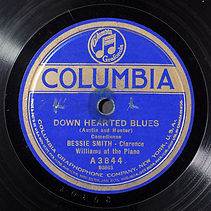
Bessie found fame when, in 1923, she released her rendition of “Downhearted Blues.” The song sold 780,000 copies in that year. Although records were not kept of music charts then, it was likely the #1 song in America. She was the highest paid black entertainer of her time. She sold 2 million records in 10 months when she signed on with Columbia Records and 6 million in the next 4 years.
Bessie cut a formidable figure at six-foot-tall and nearly 200 pounds. She had numerous lovers, both male and female, and married Jack Gee, an illiterate night watchman. This did not stop infidelity on either part. Gee’s mistress was Gertrude Sanders, another jazz singer who Gee helped monetarily with the money Bessie earned from her tours. (Her sales were not particularly lucrative as her deal with Columbia records cheated her out of royalties.) Despite his own infidelity, Gee had particular difficulty with Bessie’s female lovers. Bessie’s lovers included affairs with chorus girls in her traveling troupe, the Harlem Frolics. According to Bessie’s niece, at least one of them, Lillian Simpson, and possibly another girl named Marie, were known to be among Bessie’s lovers. Bessie, like her mentor Ma Rainey, sang songs with explicitly lesbian content, such as “It’s Dirty But Good.”
Both Bessie and Gee were known to be violent and Bessie struggled with alcoholism in her adult life. Bessie beat up Gee’s mistress, Gertrude Sanders, and accounts given in Bessie’s autobiography recount times when Gee would show up unannounced to catch Bessie in the act of infidelity and Bessie would have to run away from him. Their marriage fell apart later. One source claimed they divorced, while another said they never took the legal step.

The 1930s were not as kind to Bessie Smith. The Great Depression affected music just as it affected every other aspect of American life. Musical tastes turned to swing and jazz over the blues. Bessie’s own alcoholism also had an impact on her career decline. In 1931, she was dropped from Columbia. While she was picked up by another label, she would never see the same success she did in the ‘20s. Her last recording was in 1933. She had a touring show during the mid-1930s and even headlined at the Apollo Theatre in New York.
Record of "Down Hearted Blues"
Jack Gee and Bessie Smith
Bessie Smith performing "St. Louis Blues"
CLIENTS
Tragedy and Inequality
On September 27, 1937, she was a passenger in the car of her lover, Richard Morgan. They were driving on Route 61 in Mississippi. It is unclear if they were run off the road by another car or the structure of the road lights misguided Morgan and he ran off the road accidentally. A doctor driving on the road pulled over and helped Bessie and Morgan. Bessie had broken ribs and her arm was hurt, either by a sideswipe impact or being run over by a truck. The doctor’s companion ran for help to find a phone. However, it was taking too long so the doctor tried to put Bessie in his car, but his car was hit by another car on the road.
Eventually, an ambulance showed up for the white couple who had been in the second accident and an ambulance for blacks showed up for Bessie. It it heresay that Bessie died because she was turned away from a white hospital that was depicted in later media or that the tending doctor prioritized the white couple in the second accident over Bessie. The doctor who tended to Bessie, who was white, pointed out that a black ambulance would never take a black patient to a white hospital and the second couple was not severely injured and did not need his attention. Bessie bled out and was pronounced dead on arrival.

Bessie Smith's Funeral
Approximately 7,000 people attended her funeral, but she was given no headstone until Janis Joplin donated one later. Bessie Smith left a legacy of over 200 recordings. She was inducted into the Rock and Roll Hall of Fame in 1989. Entertainers today still credit Bessie Smith as an inspiration, a black woman who paved the way for other black entertainers to break into the mainstream market.